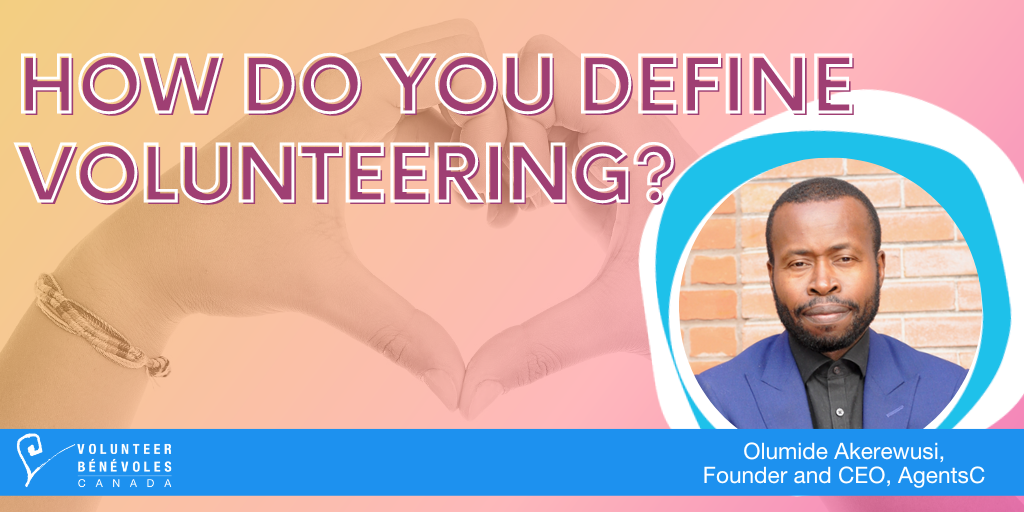
How do you define volunteering?

Mide Akerewusi • August 17, 2022

Olumide Akerewusi is a lifelong volunteer. His volunteer involvement in his early days influenced his career path in fundraising and social impact. Mide is the founder and CEO of AgentsC, a social impact organization primarily interested in the idea of equity philanthropy. He helps social impact organizations optimize their fundraising and their ability to engage philanthropists and organizations to support their work. He is often called upon to advise on how to create more equitable forms of giving and his work is valuable in helping to strengthen and sustain the non-profit sector.


Volunteer Canada sat down with Mide to get his perspective on the current state of volunteering in Canada. Our Q & A led to an interesting discussion on how we define volunteerism in Canada and how it differs across other countries and cultures. 


  • Will you talk a little about why volunteering is so important in this current context? 

Volunteering was a steppingstone to getting my first job, I graduated during a recession in the early 90s in the UK and discovered that many institutions were not interested in hiring black folk, outside of jobs involving manual labour. While unemployed and looking for work, I decided to volunteer and I discovered that I was doing a lot of fundraising, donor relations and stewardship. I also gained experience in writing letters to donors.


Since then, I have never stopped volunteering and it has been parallel to my career development, it continues to contribute to my professional interest in fundraising and I have applied that learning to my professional life. Work and volunteering have always been closely linked for me. The more I appreciate the importance of giving back, the more I want to give back.


I would love to see many more people link the power of volunteering with the power of career building, and the power of career building to the power of volunteering.


  • How do you define volunteering?
Giving my time, my knowledge, my interest, my passion, my financial resources, to causes and issues that are important to me. Becoming an investor in the livelihood of other people, being generous with those things that are at my disposal, to share with others in this understanding that we have this shared humanity.


“Injustice anywhere is a threat to justice everywhere.” Dr. Martin Luther King


Volunteering helps us tackle injustices more than any other practice. Unless we can collectively come together and tackle the issues and problems of our society, these injustices will never be solved. It’s a misnomer that institutions are the worlds greatest problem solvers – it’s people on the ground (civil society, registered charities, activist groups, volunteer groups, humanitarians) that are the ones keeping the fabric of our world together. Volunteering gives you the power to do it – it is your free will; it is all within your control – when we volunteer, we enrich our souls by helping others.


  • Why do you think volunteering will matter in the future?

Volunteering matters in the future as much as it has mattered in the past. Volunteers have played a role across every sector of our society – like keeping corporations and governments accountable, executing major movements such as the civil rights movement, and demonstrations such as Black Lives Matter, which have catalyzed the global conversation about systemic anti-Black racism.


We need to extricate ourselves from constant conflict, so unless volunteers are mobilizing to heal our world, we are going to be at a very dire place. There will be no time in our human existence that we won’t need volunteers – people to uplift the dignity of those who are oppressed, those who are marginalized.


The beauty of volunteering is that you can choose where your intersection is. That spirit of protest is intertwined in volunteering, today we call it activism, but that is an entirely volunteer led initiative.


  • What types of infrastructure supports does Canada need to consider as it pertains to the ways people want to contribute and volunteer in the future?

I think the current Canadian infrastructure is counterculture to volunteering. The culture of volunteering in Canada is very different than my African culture and British culture. My #1 observation is that white Canadian culture is solitary. It prioritizes the individual rather than the community, so volunteering can help people in Canada connect with their communities. In the UK, volunteering forces you into collective action, protesting and standing up for rights. On the African continent, and other parts of the global south, volunteering leans towards helping our neighbours. Wherever or however volunteering is practiced, it involves a community of like-minded people who share the same aspirations. It encourages you to think about the broader community and takes you away from self-preoccupation.


Time is probably the most equitable asset – and part of the challenge in our society is how to figure out how many of those hours we want to invest in the lives of others and who we consider to be a volunteer.


Is there something the government or employers can do to support volunteering? Yes. I would like to see more people volunteering with and for Black-serving, Black-focused, and Black-led causes. But I don’t believe we can rely on governments and corporations to set our mandates for volunteering. We are the community; we have the responsibility to volunteer and build our communities.


  • Anything else you want to share from your perspective as a leader in this field?

Volunteering from the perspective of the black immigrant in Canada, it is important that we also try to understand how different communities and cultures view volunteering. The term “volunteering” might not be common in many places, but the act that we label as volunteering is.


The idea of “volunteering” does not exist in many immigrant cultures in Canada – instead, (as in my case), it exists as a way of life. There are concepts and words around the world that describe what it means to be in community – what our responsibilities in community are. There are concepts about our role in society, to help others in society. The word that comes to mind is the Bantu term – Ubuntu (I am because we are). So, for charitable, corporate, and government institutions seeking to engage diverse cultures in Canadian volunteering, those invitations need to be culturally appropriate to those you are inviting. There are many ways to view, understand, and engage in volunteering. One of those ways is to learn how Black people practice Ubuntu, and apply this concept to your volunteering strategy/practice.


At Volunteer Canada, we seek to learn about the many and varied volunteering experiences of Canadians. Join the conversation, and share your story, at empathyinaction.ca.


Originally featured on https://blog.volunteer.ca/how-do-you-define-volunteering/

Explore More from Giving Black™

By Mide Akerewusi • September 30, 2026
Dreams do come true. On the eve of the Giving Black Virtual Conference and Soirée, I am reflecting on my learning journey since planning our incredible gathering. This is literally a dream come true. I had thought about a climate action conference that tells the varying histories and stories of Black and Indigenous people as stewards of land, sea and air, and here we are. As we enter the Fall, I'm considering climate action in the context of the things I knew nothing about but learned on the way as a convenor of this important Black climate action discussion. July was a memorable month. My long-time friend from London, Englan d, Chris East BSc hons MCIOF was visiting Toronto for a conference. We met on July 15, on a day when the sky turned orange and the air became thick with smoke. Wildfires burning across northwestern Ontario had sent smoke hundreds of kilometres south, filling Toronto’s air with fine-particle pollution. For much of that morning and afternoon, Toronto sat at the top of global air-quality rankings. I tried to convince my friend that this was not a typical day in Toronto but we both feared it may become a trend.
August 27, 2026
Alex Adewole is a Business Architect and strategic thinker. Professionally, Alex has spent more than a decade helping organisations navigate complex change across government, financial services and the private sector.
By Mide Akerewusi • August 24, 2026
My Friend and Brother Julius Lindsay (he/him) a gifted and talented Climate Action expert posted a message that deeply resonated with me this morning. Here it is and below is my response: Julius Lindsay (he/him) Orginal Message... I recently had a meeting with a colleague who congratulated me on the stuff they had seen on here of all I have been up to this year.I've been bus y: moderating, panels, writing, winning awards. I've been doing a lot. By a lot of standards I've been winning, literally and figuratively. My feed looks great.And yet I am still unemployed. Contract work has been hard to find. Grants for projects have been hard to come by. I'm worried about my financial situation.I had a Black colleague say they thought I was too slick to experience harm and racism. Probably partially driven by that ongoing winning in my feed.And yet I have had some really traumatic experiences in this work, some of them play out in public spheres (if you've been here a while, you've seen some of them). I feel like as a Black person its impossible to avoid them. And their weight endures years after they happen.This is the duality of working in the this field, existing in this time, social media vs. real life. The internal and external struggles not always showing up, the shiny things being most visible.I'm doing my best to do what I can to figure things out and get to a better place. But it's hard, especially on days when the sky is orange.I don't have some grand declaration at the end of this post. Don't take this as a cry for help (although help is appreciated!) but just as a quiet reminder that visibility isn't reality and people might be struggling more than you think. Check on YOUR people. Mide (Olumide) Akerewusi, B.Sc., M.Sc. (Econ), CSR-P, CDEP. Response.... Bro! Thanks for sharing. You are one of the most gifted Climate Action experts I know, and I have HUGE admiration for you. There is never a time we meet that I don’t leave FAR BETTER informed than I was before. Your contribution to the Climate Action landscape has totally changed my mindset and that of several others in our community! Our sector is fortunate to have you. And I feel that we are all genuinely in awe of your awesomeness. Could it be that while we personally struggle, others do too? But perhaps our struggles as Black men in various sectors are compounded, and complicated by the systems we work in, and the skin we are in, and what that skin represents, and how we are perceived and treated? The propensity to have our work trivialized, reduced, erased, and othered, viewed as less-than, and inconsequential, something that the mainstream can survive without and does not need; is so thick, I sometimes feel as though I can cut it with a knife and serve it as a bitter dish! For sure we experience success. It's not all doom and gloom. But Black success seems to have a short life-span in comparison. We are cameos, seldom ever the bright burning stars of this rolling movie... What Happens When We Feel The Pinch? What happens when we all feel the economic pinch? For sure, some feel it more than others, especially Black, Indigenous, and intersectional folks. Perseverance is our only choice! Giving up is not an option. When hardship becomes too hard to bear, we need people around us to provide that extra level of support. I love support because at its best, it has mutual benefit. But we need more of it because what we carry requires more energy. Do you know what I mean? Unicorn Black Men And Universal Issues Brother, I’ve had loads of conversations about the importance of Black and Indigenous voices in the Climate Action space, since focusing this year's Giving Black Conference on this issue. And I’m often met with curiosity about why such a distinct voice is even necessary. There seems to be an indifference within the climate sector towards racialization, while across the broader non-profit sector there is still inertia about how deeply climate affects our collective health, artistic, sporting, social and economic wellbeing. When we turn up in our Blackness, things are sometimes not viewed in the same way. You, my brother (along with many other Black men in the sector - including me), are somewhat of a Unicorn. And Unicorns are not always easy to mainstream - especially in times of collective crisis. Admirers, Admirers, Everywhere, And Not A Job In Sight Despite our many admirers, we remain on the periphery of full acceptance/integration into the systems of Contracts, RFP's, Engagements, and Paid Work. We are are often remote from consistent opportunity! I hear you when you speak about the difficulty of navigating this moment as a Black man in the sector. It’s real, for REAL, and I respect you for making the distinction between accolades and active employment. They are poles apart! I’ve experienced it too. People tell me how successful I am. Ironically, this "success", sometimes, I think, is due to my activism, which in and of itself comes at a price. It's one thing to have an opinion and a position on a principled or divisive issue, and exercise ones liberty to share it with others. It's quite another thing to get work thereafter! Speak and be damned! The Need For Tremendous Leadership I've said many times, our sector has a habit of avoiding the realities we face. We need inner strength to truly fight for what we believe. If we shy from impacting the world, the world will most certainly impact us. Surely, this is the echoing call of Climate Experts such as yourself. And this is an area that requires tremendous leadership - standing up for what we know to be right - despite the price/cost to us personally. And no doubt there must be a price and cost to the equity we pursue. Freedom Ain't Free! Awards, likes and re-shares continue, while meaningful action, employment and practical solutions remain elusive to Black folks in our sector. These are weekly conversations I have had with many people in my network, since the licence to abandon any thought of equity was granted, more than a year ago. There's som ething so necessary and yet so disposable about Black thought these days. This is a conversation I had with our Sister Sade Dozan, CAP®, CFRE on a recent podcast discussion. We Need REAL Solutions That’s exactly why we need to get into these conversations, rather than avoid them. Once again, thank you for sharing such a powerful message, that immediately stirred an emotional and concerning response within me. I'll join you in looking for real solutions that support our perseverance and maybe even changes our respective landscapes. It seems to me that we have many more years of concern to come. One solution is to convene and work things out collectively, rather than separately. I am game if you are. All are welcome to DM me if you agree.... Have Zoom, will set up!

Stay Connected


Join our mailing list to receive conference updates, speakers announcements, and opportunities to engage with the Giving Black community.