Saved By Sabbatical: Part Two Of A Two-Part Story About Exiting Grind Culture
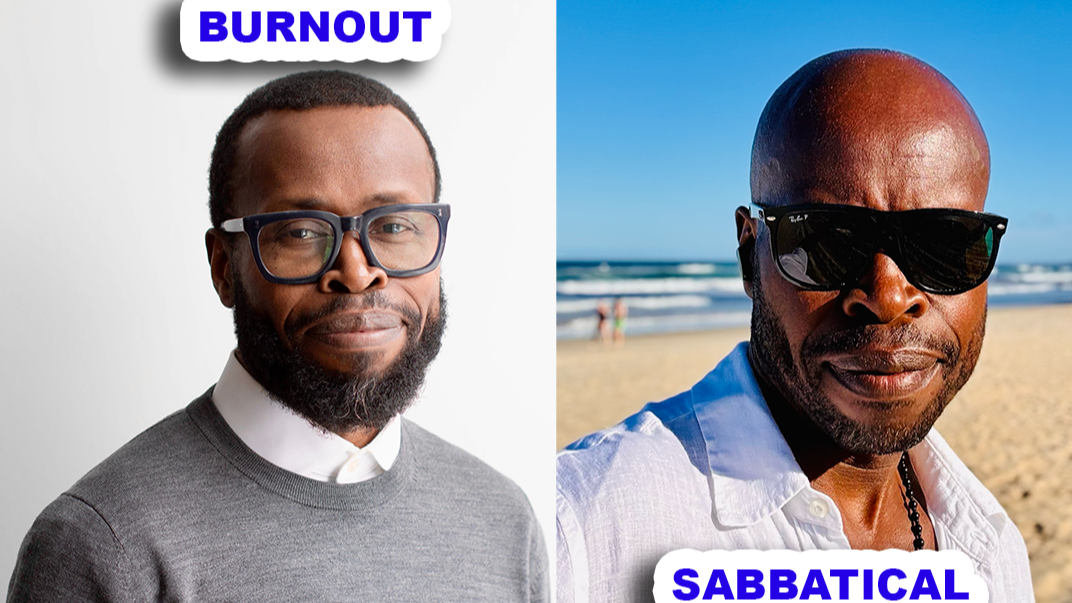
This story is the second part of a series of two stories focused on the cause of burnout and the solution for recovery, a sabbatical.
The first story, “Burdened by Burnout” can be found here.
Spelling out B.u.r.n.o.u.t.
Recently, I spoke with a Black CEO who said, “I always thought burnout was just something white people complained about.” For a long time, this CEO had dismissed burnout as a legitimate condition—viewing it as a classic example of fragility and privilege. That perspective shifted dramatically when the CEO came to recognize in themselves, the classic symptoms of burnout through continuously working very long hours and harbouring feelings of work-related stress. They felt they had no clear solution to either prevent, minimize, or solve their situation. Upon this realization, the CEO took matters into their own hands, resigning from their position.
Their experience as a CEO isn’t uncommon, and indeed gives us greater insight into the burnout phenomenon. A report from Velocity Advisory Group indicates that approximately 70% of high-level executives have considered quitting to improve their emotional well-being. Juno Health reports, that CEO burnout is a major driver of leadership turnover, with 70% of leadership departures attributed to burnout.
Approximately 70% of high-level executives have considered quitting to improve their emotional well-being. Juno Health reports, that CEO burnout is a major driver of leadership turnover, with 70% of leadership departures attributed to burnout.
Another friend and CEO, Rickesh Lakhani, wrote of his experience of burnout:
“I've been open about my experiences in crashing hard during a time when everything bad convened all at once, and even though I thought I was fine, I didn't really realize how bad I was until I stopped, or maybe more accurately, crumbled.”
Burnout is a universal condition—one that affects anyone who works long hours relentlessly, regardless of race, and whether they acknowledge it or not. However, the gap between burnout and our understanding of it may be tied to the fact that it is not easy to diagnose.
According to The Canadian Centre for Occupational Health and Therapy, burnout is described as "Physical, emotional, and cognitive exhaustion - feeling frustrated, tired of going to work, finding it hard to deal with others at work; negativity or cynicism – being less empathetic with others, detached from work or responsibilities, seeing work or elements of work as a source of frustration; ineffectiveness or low personal achievement – a lower sense of accomplishment and self-worth, self-doubt, experiencing work as unrewarding, feelings of 'going through the motions’; being incompetent, feeling unappreciated; depersonalization – thoughts and feelings seem unreal or not belonging to oneself.”[1]
In any normal circumstance, this troubling list of symptoms would warrant serious attention and deep concern. Yet, when labeled simply as “burnout,” it often fails to evoke the urgency it deserves. We tend to speak of burnout as though it were no more than a minor cold. In reality, it is far more harmful and significantly more detrimental to our health than its connotations imply.
“I’ve been open about my experiences in crashing hard during a time when everything bad convened all at once, and even though I thought I was fine, I didn't really realize how bad I was until I stopped, or maybe more accurately, crumbled.” – CEO, Rickesh Lakhani
So, what happens when an employer recognizes burnout in an employee? What solutions are available?
Surprisingly, there is a “Burnout Inventory” of tools that purportedly help to measure burnout, in eluding the Maslach, Copenhagen, and Oldenburg approaches, Workplace Strategies for Mental Health (WSMH), an initiative supported by Canada Life, has a number of tools and resources for employees to deal with burnout, including a self-assessment to support their success. WSMH, encourages employees to revisit their Job Description with their supervisor to clarify expectations, manage performance, identify formal and informal accommodations, and develop a sustainable return-to-work strategy.
These methods, while well-intentioned, help to safeguard work continuity and minimize HR risk for the employer, rather than create an easy path for employees to personalize their response to burnout. For many employees, they may already be too burned out to even initiate the recommended steps toward recovery. Others, especially those in C-suite positions, may feel that admitting to burnout and requesting time off could be unwise and a career-limiting move. Additionally, there are also self-employed CEOs of small businesses, like me, for whom the standard recommendations for addressing burnout are not feasible in the absence of resources that are available to larger organizations.
These definitions, tools, and remedies curiously avoid naming the cause of burnout. And this is where I think all conversations regarding burnout must start – why does it exist?
Black Culture and Burnout
In part one of this essay, I described some of the challenges faced by Black immigrant entrepreneurs like myself. Here, I aim to explain why I allowed myself to burnout, starting with my culture, lived experience, and philosophies about the role and purpose of work—things that shaped my interpretation of, and responses to, burnout.
Watching TV one day, I listened to African-American businessman and serial entrepreneur Daymond John, Founder of FUBU, state that one of the biggest benefits to being Black and in business, is that “nobody sees you coming.” Quite literally, Black people in business are invisible to the mainstream–until or if, we are successful in the mainstream. As a CEO, I wanted to be seen and to be successful, and I was clearly willing to pay the price. My work addiction was self-inflicted. It was strategic, intentional and in large part circumstantial.
One of the biggest benefits to being Black and in business, is that “nobody sees you coming.”
– African-American businessman and serial entrepreneur Daymond John, Founder of FUBU.
In my particular culture as a Black, African-European immigrant in Canada, work and most especially hard work is an undeniable cultural reality. Mine is a Black identity steeped in the ethic of overcoming all barriers at all cost, and using one’s education and instinct to progress in an unfamiliar environment. Additionally, my culture is geared towards the workarounds—helpful in confronting a problem one does not fully understand or participating in systems that are not built with Black people in mind. And yet I find myself in the Western world, attempting to establish Black participation. As far as success is concerned, I harboured a singular obsession: to be the best CEO doing the best work with the best causes and the best people. This was how my burnout started. And it was what led to me needing a sabbatical to recover.
If We Don’t Grow Old, We Die
The New Year of 2024 opened with a tally of 14 clients at agentsC—our largest ever work roster—while I was also leading two other entities simultaneously, Giving Black, and the beleaguered Association of Fundraising Professionals chapter in Greater Toronto. I had lost some staff, due to the fact that my initial vision for agentsC was eroding. I wanted to be values-led but found myself in a world of budgets, cashflows, and payroll obligations. It’s hard to admit now but I lost the grip on my business, and was both distracted and overwhelmed by my often-conflicting responsibilities and perpetual tiredness.
The pace and pathos of my work life made me miss some important business meetings, turn up late for others, and I also missed important landmarks outside of work: birthdays and marriages of those I loved, and other social gatherings. I could not keep up because I said “yes” to everything work related – requests to meet, requests to speak, requests for support, requests for proposals; all required time and energy investment. My calendar was filled with consecutive meetings. A typical meeting lasted a minimum of an hour, to in-depth discussions with multiple people lasting half or a whole day. I was unable to say, “no”. Last thing at night and first thing on a weekend, my laptop would be open for work continuity.
Busy workers get sick and some die. I knew my cohort of Black men had among the poorest health stats in Canada[2], the UK[3], and USA[4] – probably even globally. I had read articles about relatively young leaders and celebrities experiencing heart attacks, cancer, and strokes: John Singleton, Toni Braxton, and Michael Johnson, to name a few. I also had my fair share of sad stories of close friends who passed away, in their forties and fifties; "Too young", I thought to myself.
One day I complained to my mother that the strains of work, my increasingly poor health, and middle-age were proving tough for me to juggle. Her reply caused me to stop in my tracks; she said, “if we do not grow old, we will die.” This very African proverb felt more like a warning than an irony. I thought about what she meant. I was grateful to be alive but I was feeling increasingly vulnerable, often sick, and very mortal. I was fearful of a personal catastrophe and doubted whether I would see the year through unscathed. While I prayed about it, wondering if I would have the opportunity to grow old or if I would meet a similar fate as my unfortunate peers, I nonetheless continued working unabated, unwilling and unable to stop my work addiction.
I had felt burned out several times in my career, but I was also able to temporarily recover, which in hindsight actually prolonged my burnout, rather than cured it. A new work project, an exciting challenge or a couple of weeks off, at least created a distraction from fatigue. And so, a pattern was developed: get burned out, then mask burnout with something new. I noticed that the frequency of feeling burnout was higher from once or twice a year to every three months. At the peak of this burnout, I always created an even bigger cover to try to mask it, like booking as many overseas work trips as I could. Then I noticed that with travel came even greater levels of insomnia, which aggravated my symptoms, and that I had far less energy than the previous escape. I call this compound-burnout, where things get worse and one’s ability to recover is routinely minimized, caused by a sense of hyper-responsibility, an unreasonable belief that I was responsible for everything.
As a long-suffering insomniac I knew no limits—I would work throughout the day and past dusk and into dawn. I would take a two-hour nap at around 5:00am and a wake up at 7:00am. Work would resume nonstop soon after. At times it was 2:00pm before I realized that I had not eaten since a late 12:00am meal the night before. Skipping meals was diminishing not only my levels of nutrition but also my weight and my strength.
Weakness set in. I could feel it. I was constantly doing more and more and more. Though I had some good habits that served as helpful intervals during my working day, such as cooking and eating nutritious meals, working out, and listening to music; I found I could not stop working. A change may be as good as a rest, but merely changing one’s work style or introducing incremental distractions and hobbies were no guarantee for burnout recovery. There's a real distinction between doing work differently, and not working at all. I knew this because I had trialed other kinds of remedies for my burnout: Fridays off before public holidays, no work on Sundays, no meetings on Mondays, work days that start at 10:00am. None helped, and only all delayed the inevitable breakdown. As one held hostage to work, I didn’t need work to be easier; I needed work to stop.
While I prayed about it, wondering if I would have the opportunity to grow old or if I would meet a similar fate as my unfortunate peers, I nonetheless continued working unabated, unwilling and unable to stop my work addiction.
Saved by a Healing Sabbatical
In the middle of 2024, I find myself in a strange situation—meeting the growing demands of work, while intentionally winding down to protect my mental health—when an opportunity for escape lands in my orbit. My daughter, who recently returned from working overseas, announces she's on the move again—this time to the other side of the world: Australia. Without hesitation, I tell her, “I’m going with you!” I decide—spontaneously and with conviction—to begin the sabbatical I had dreamt about two-years prior.
A sabbatical is an extended period of time off work, to rest, engage in play, and allow for restful dreams and reflections. I knew that work liberation was the best cure for my burnout. I saw it clearly the moment I began plotting our daughter-father escape. Initially I planned for a month, then two, then three, then four. Eventually I opted for a five-month sabbatical. On December 20, 2025 I completed the last of our 14 projects that year and I finally put an end to my obsession and addiction to work.
I left for Australia early in January 2025, and began to put my life back together piece by piece. Rest placed me in a position where I could think deeply about my mental welfare, physical welfare, and spiritual welfare (mind, body, and soul). I was committed to changing things for the better.
At the beginning of my sabbatical, I discovered new facts about my relationship with work, most of which I am able to articulate in this essay. Then I began to regret making so many sacrifices for the sake of work. Being with my daughter and missing my wife, son, and friends while away, made me appreciate much more deeply that I had a family of spectacularly wonderful people and a friend circle that was quite simply brilliant. I considered how blessed I was. I committed to never again sacrificing my family and friendship for a work-priority – at least not consistently and not as an uncontrollable habit. I decided to demonstrate more clearly the ways I could show up and turn up for my family and friends, that I had neglected for so long. And then I decided to have fun and seek joy, and not allow work to snatch time away from me so easily.
A sabbatical is an extended period of time off work, to rest, engage in play, and allow for restful dreams and reflections. I knew that work liberation was the best cure for my burnout.
Creating Personalized Systems for Rest
I’ve come to understand that my culture and upbringing—along with the insecurities I carried about being Black in business, being an immigrant, and constantly feeling the need to prove my worth in the workplace—were not only signs of resilience, but also survival strategies I adopted in the absence of compromise or other feasible options. I was not prepared to give up on my aspirations to be seen and heard but I knew no other way than to work unreasonably hard to pursue these goals. While it saddens me to write this, knowing that many other people share this reality, I hold hope: hope for a life where striving to be seen as worthy does not demand such a high penalty. I did not know of any other form of being than being a work being. And now once again, I feel like a human being.
I know that as a human being, I am inherently worthy—and that worth is not tied to my work. My character, and what I do beyond the confines of my job, are what truly matter. Yet, resting from work remains incredibly difficult, especially when our livelihoods depend on our ability to earn, to be promoted, or to be rewarded—whether through money, clients, future prospects, or financial security. But rest from work does not have to equal loss. I believe it’s possible to form lifestyles that reassure us that rest is not only necessary but potentially just as valuable and rewarding as work—if not more so. So how do we do that? I believe we must first approach rest as systematically and intentionally as we approach work.
I needed to make specific decisions and accommodations to prepare for my sabbatical. I asked myself: What will it mean to walk away from work—entirely? The answers that came back were not always easy but I figured out how to commit to them as necessary building blocks to rest over work, and heal from burnout:
- Having a plan: I set rest goals for myself and sought buy-in from my family, explaining why my sabbatical was needed.
- Informing clients: This process was difficult as it meant that I had to be prepared to lose earnings, as well as the opportunity to work with incredible people – something which I loved doing.
- Closing down: I had to be firm in my decisions, and ability to close agentsC. Whether it was winding down client contracts, ceasing work with staff and associates, letting go of the company was necessary for my own healing.
- Planning for income loss: My sabbatical lasted five months. Months, prior to taking this break from work, I tried to live as frugally as I could, and I secured a line of credit to remain financially stable.
- Accountability partners: I needed people in my life who would ensure follow-through on my commitment to rest. Frequently we would discuss what rest meant to me and how I would build it into my life as a burnout recovery method.
- Total detachment: I deleted all work-related communication and social media apps from my phone (except WhatsApp), and chose not to travel with any other device—no laptop and no iPad.
- Leaving Toronto/my home city): I felt that staying in my city would invalidate the essence of my break. I wanted to indulge my affinity for small coastal communities, where the sounds and sight of the ocean would be daily therapy.
- Love-language living: I poured myself into what I love most—cooking for others, and spending time with people. Domestic chores become a joy, as did laughing, and simply being present in each moment without worrying about work.
- Curiosity over productivity: I explored new places—concerts, restaurants, unknown towns. I met strangers and made new friends. I stayed curious. I kept my mind socially active, overriding thoughts that were once dominated by work.
- Wellness rituals: I re-focused on healthy eating, doubled down on my gym routine, and found escape long beach days. I would sleep in the sun, soak in Vitamin D, and let the ocean reinforce my melanin and my joy.
I know that as a human being, I am inherently worthy—and that worth is not tied to my work. My character, and what I do beyond the confines of my job, are what truly matter. Yet, resting from work remains incredibly difficult, especially when our livelihoods depend on our ability to earn, to be promoted, or to be rewarded—whether through money, clients, future prospects, or financial security.
What I learned: My Journey From Absolute Burnout to Healing Sabbatical
I am back from a five-month break that resulted in incredible healing. I returned to work in May 2025. I have gradually re-introduced myself to what is a manageable pace of work. Not only am I well rested, I feel more energized. My joy has returned, and so has my love for making a difference. Going on sabbatical and ceasing all work for an extended period of time was the best gift I could have given myself. I now know how and why over-work, hyper-responsibility, compound-burnout, cognitive exhaustion, Black-immigrant and in business status, and over-ambition, can spiral into a mode of self-inflicted harm through a lack of rest. I know the dangers of being busy, and being in denial about unhealthy work habits.
I also know that life is too short to invest so much time in work. Most importantly, I know that there are diminishing returns and incalculable sacrifices that surround people who do not rest. Irrespective of race and culture and in some cases because of race and culture, burnout is a universal phenomenon whose impacts are too little understood and solutions far too inadequate to prevent or address.
I also know that recovery from burnout is possible – for me, it was a complete removal from work in the form of a sabbatical, which required certain sacrifices and and yet yielded so many rewards: healing, resting, reconnecting, reclaiming time, being with those I love, seeing and loving life, travelling, giving room for spontaneity, allowing for boredom and the mundane, investing time in things I like, devoting myself to self-reflection, and entertaining my curiosities for new environments and the people and communities who live next to and far away from me.
I want to retain this feeling, so that I can be a better and more complete person. I am open to exploring new ways of approaching work, while safe-guarding my mental health and maintaining my joy.
However you choose to prevent, diagnose, or recover from burnout, I hope you will give serious consideration to your personal rest journey. If you experience burnout, examine your condition from the perspective of your culture, lived experience, and your work philosophy—its role and purpose and understand why it exists. Recognize your responses to burnout—whether they help to remedy or only exacerbate the situation instead—and chart your recovery path. Regardless of the type of remedy and duration, be prepared for the economic repercussions, and plan well in advance with the support of your family, especially in the reworking of your finances and family budget.
I believe that rest manifests differently within different people. For me, planting my feet in sand and sea are important to feeling safe in rest. For others, climbing a hill or mountain creates a Zen-like feeling. Whatever you determine to be restful, I hope these essays are helpful to you.
However you choose to prevent, diagnose, or recover from burnout, I hope you will give serious consideration to your personal rest journey. If you experience burnout, examine your condition from the perspective of your culture, lived experience, and your work philosophy—its role and purpose and understand why it exists. Recognize your responses to burnout—whether they help to remedy or only exacerbate the situation instead—and chart your recovery path.